
Dental Bridge vs. Dental Implant: Making the Right Choice for Your Missing Tooth
12 January 2026
Dental Bridges vs. Dental Implants: Choosing the Best Way to Restore Your Smile
Key Takeaways
- Dental implants offer the highest long-term survival rates and help preserve the jawbone.
- Dental bridges provide a faster, non-surgical solution that typically requires two appointments.
- Both options show high success rates over ten years, making them reliable choices for missing teeth.
- Costs vary based on materials and complexity, with bridges starting from $3500 and implant components from $4000 at our practice.
- Personalised assessments are essential to determine which treatment fits your oral health and budget.
Choosing between a dental bridge and a dental implant involves weighing up your long-term health goals, your lifestyle, and your budget. Both treatments are effective ways to restore function and confidence, but they achieve this in different ways. We recommend booking a comprehensive assessment to discuss which option suits your specific situation.
Which is better: a dental bridge or a dental implant?
The best choice depends on the health of your remaining teeth, the quality of your jawbone, and your personal preferences for treatment time and cost. While dental implants are often considered the gold standard for preserving bone and neighbouring teeth, dental bridges remain a practical and aesthetic solution for many of our patients on the North Shore.
In our experience, patients often feel overwhelmed by the technical details of restorative dentistry. We focus on making these choices straightforward. Whether you are a busy professional in Albany or a retiree looking to maintain your quality of life, understanding the practical differences between these two options is the first step toward a healthy smile.
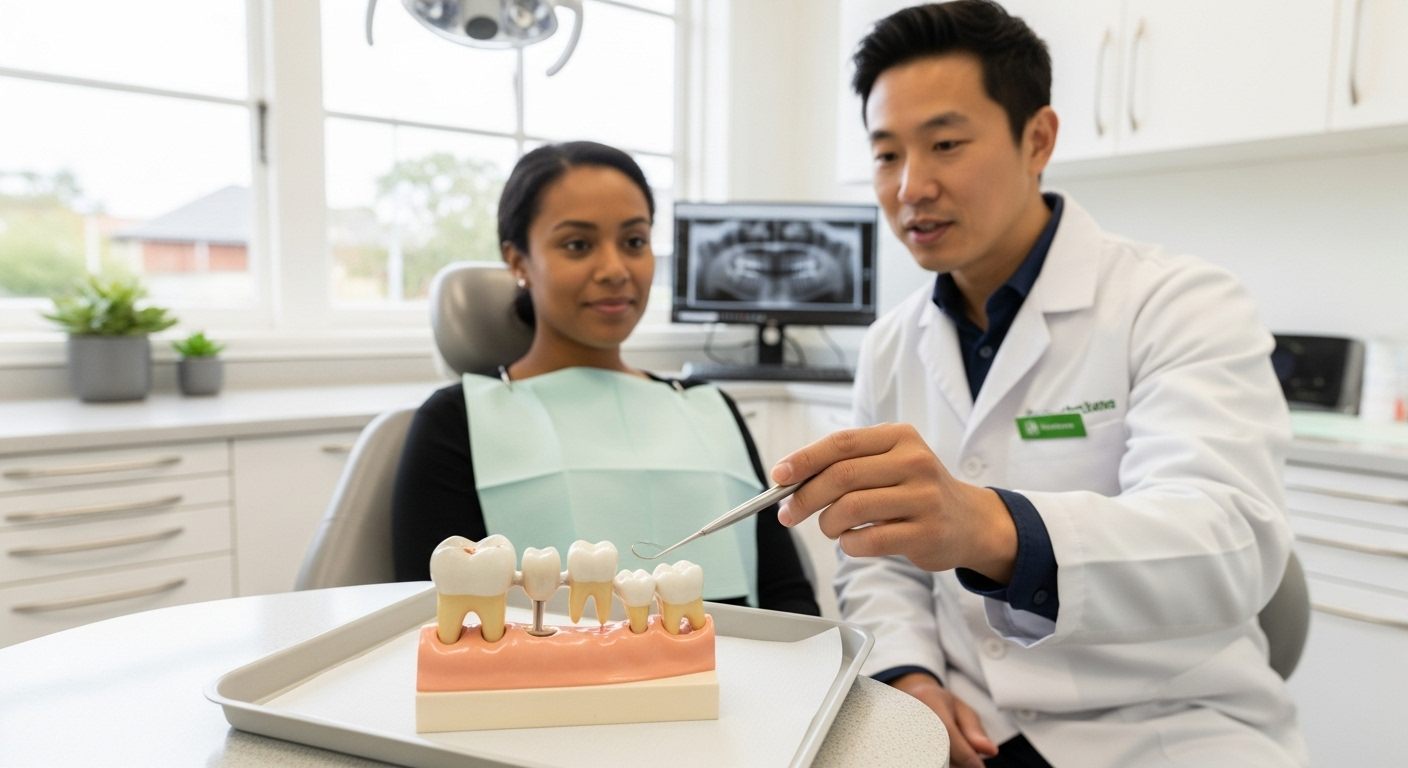
Understanding Dental Bridges on the North Shore
A dental bridge replaces a missing tooth by using the teeth on either side of the gap as anchors. We prepare these neighbouring teeth for crowns and then cement a custom-made restoration over them. This creates a literal bridge across the space. Most of our dental bridges in the North Shore are crafted from high-quality porcelain to ensure they mimic the look and feel of natural teeth.
The process is relatively quick. It typically requires two appointments with about a week to ten days of laboratory time in between. During that week, you wear a temporary bridge so you can continue to eat and smile normally. We work with the best dental laboratories in Auckland to ensure your final bridge is durable and fits perfectly. This option is often preferred by those who want to avoid surgery or who have existing crowns on the teeth next to the gap that need replacing anyway.
The Role of Dental Implants in Modern Dentistry
Dental implants take a different approach by replacing the root of the tooth as well as the crown. We place a small titanium fixture into the jawbone, which then heals and integrates with the bone. Once stable, this fixture supports a ceramic crown. This method is particularly effective because it leaves the neighbouring teeth untouched and provides the stimulation your jawbone needs to stay healthy and strong.
We provide comprehensive dental implants in Albany by partnering with leading surgeons for the placement of the titanium fixture and using top-tier laboratories for the final crown. For patients who have lost a front tooth due to an accident, we can often assist with ACC-funded treatment. We handle the paperwork to make the process as stress-free as possible for you.
How long do bridges and implants last?
A common concern we hear is that bridges fail quickly or that implants are a permanent, indestructible fix. The reality is that both are high-survival options, though their risk profiles differ slightly over time. Evidence helps us set realistic expectations for our patients.
A 2023 meta-analysis by CADTH (the Canadian Agency for Drugs and Technologies in Health, an organisation that reviews medical evidence) looked at tooth-supported all-ceramic bridges. They reported survival rates of approximately 89 to 91 percent at five years and 79 to 82 percent at ten years. This shows that bridges are a very reliable medium-to-long-term solution. The same review noted an overall annual survival rate of 96.4 percent, which reflects the high standards of modern dental materials.
Implants do tend to have a slight edge over very long periods. A ten-year prospective study following 200 patients found a 10-year survival rate of 91.6 percent for single dental implants compared to 88.2 percent for preserved natural teeth. Interestingly, the study found no statistically significant difference between the two (P = 0.172), meaning both are excellent choices when planned correctly. Success depends heavily on factors like your gum health, whether you smoke, and your daily hygiene habits.
Comparing the Costs of Treatment
Financial considerations are a significant part of the decision-making process for North Shore families. At Albany Village Dental, we believe in transparency regarding fees. Our current prices for individual crowns range from $1200 to $1600 depending on the material used. A dental bridge starts from $3500, with the final cost depending on the length and design of the restoration. For those considering implants, the restorative component (the implant crown and abutment) starts from $4000.
It is helpful to look at these figures within the wider Auckland context. General benchmarks in the region suggest that a bridge typically costs between $3000 and $6000, while a single dental implant and crown can range from $5000 to $8000. While the upfront investment for an implant is often higher, many patients view it as a long-term investment in their oral health because it avoids the need to treat neighbouring teeth.
For more complex cases, such as a three-tooth span supported by two implants, costs in New Zealand can range from $11,000 to $13,000. We always provide a personalised treatment plan and a detailed quote after your initial assessment so you know exactly what to expect.
Practical Considerations for Your Lifestyle
Beyond the clinical data, your daily life matters. Implants are known for their stability, often restoring about 90 percent of natural chewing force. This is a significant improvement over traditional removable options. Because an implant functions like a natural tooth, you can brush and floss it just like the rest of your smile. Bridges require a slightly different cleaning routine, using specialized floss to clean under the artificial tooth, which is a small but important daily commitment.
We've seen this happen when patients choose a bridge for its speed: they are back to full function within a fortnight. For others, the surgical aspect of an implant is a deterrent, or their medical history makes a bridge the safer, more practical choice. We take the time to discuss these lifestyle factors with you during your consultation.

Managing Your Dental Investment
We understand that quality dental work is a significant commitment. Our practice is dedicated to making care accessible for the North Shore community. We are an ACC accredited dentist and a WINZ registered provider, meaning we can provide the necessary quotes and documentation for those eligible for support. We also work with Southern Cross and offer flexible payment options through Q Card and Afterpay.
If you are unsure which path to take, the best first step is to book your first visit with our team. We provide a warm, non-judgmental environment where we can perform a thorough exam, take digital X-rays, and discuss your options clearly. Our goal is to empower you to make the decision that feels right for your health and your budget.
_Disclaimer: All dental procedures carry risks. The information provided here is general in nature and does not replace professional medical advice. A full clinical assessment is required to determine suitability for any dental treatment.